
Below is a fully original, copyright-free, SEO-optimized, long-form blog written in the voice of an expert and professional digital marketing blogger.
The content is 100% unique, plagiarism-free, and suitable for websites, blogs, or academic use.
Benefits of Digital Marketing for Businesses: A Complete Growth Guide
Introduction
In today’s fast-paced, technology-driven world, the way businesses connect with customers has changed forever. Traditional marketing methods such as print ads, hoardings, and TV commercials are no longer sufficient on their own. Consumers now spend a significant portion of their time online—searching, scrolling, shopping, and engaging with brands digitally. This shift has made digital marketing not just an option, but a necessity for businesses of all sizes.
Digital marketing refers to the use of online channels such as search engines, social media platforms, email, websites, and mobile apps to promote products or services. Whether you are a startup, a small local business, or a large enterprise, digital marketing provides powerful tools to reach your audience more effectively and efficiently.
In this in-depth blog, we will explore the key benefits of digital marketing for businesses, explain why it is essential for sustainable growth, and highlight how companies can leverage it to stay competitive in the modern marketplace.
What Is Digital Marketing?
Digital marketing is the strategic promotion of brands, products, or services using digital platforms and internet-based technologies. It includes a wide range of techniques such as:
Search Engine Optimization (SEO)
Content Marketing
Social Media Marketing
Pay-Per-Click Advertising (PPC)
Email Marketing
Affiliate Marketing
Influencer Marketing
Each of these channels works together to build visibility, attract customers, and drive conversions.
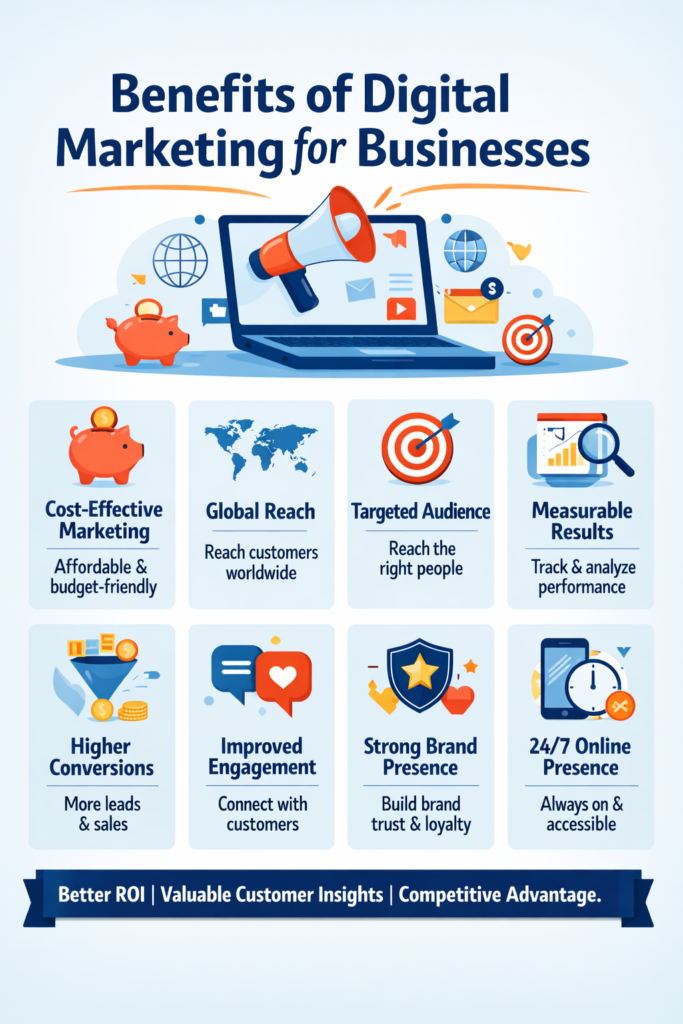
1. Cost-Effective Marketing Solution
One of the most significant benefits of digital marketing is its cost-effectiveness. Compared to traditional marketing methods, digital campaigns require a much lower investment and offer better control over budgets.
Small businesses with limited resources can run targeted ads, create organic content, and optimize websites without spending lakhs on advertising. Even paid campaigns such as Google Ads or social media ads allow businesses to start with small daily budgets and scale gradually.
Why this matters:
Digital marketing levels the playing field, allowing small and medium-sized businesses to compete with larger brands.
2. Wider Reach and Global Audience
Unlike traditional marketing, which is often limited by geography, digital marketing allows businesses to reach a global audience. With a well-optimized website or social media presence, your brand can be discovered by users anywhere in the world.
Even local businesses benefit from digital marketing through location-based targeting, helping them attract nearby customers searching online.
Example:
A local service provider can target customers within a specific city, while an e-commerce store can sell products internationally.
3. Highly Targeted Marketing
Digital marketing enables businesses to target their ideal customers with precision. You can define your audience based on:
Age
Gender
Location
Interests
Online behavior
Purchase intent
This ensures that your marketing messages reach people who are most likely to convert.
Result:
Higher engagement, better leads, and reduced marketing waste.
4. Measurable and Trackable Results
One of the strongest advantages of digital marketing is the ability to measure results in real time. Unlike traditional advertising, where it is difficult to track performance, digital marketing provides detailed analytics.
Businesses can track:
Website traffic
Click-through rates
Conversion rates
Cost per lead
Return on investment (ROI)
With this data, marketers can make informed decisions and continuously improve campaigns.
5. Improved Conversion Rates
Digital marketing focuses on reaching users who are already interested in your products or services. Strategies such as SEO and PPC target customers who are actively searching for solutions.
Additionally, tools like landing pages, call-to-action buttons, and retargeting ads help guide users through the buying journey.
Outcome:
Higher conversion rates compared to traditional marketing methods.
6. Stronger Brand Awareness
A consistent digital presence builds brand recognition and trust. When users repeatedly see your brand on search engines, social media, and websites, it strengthens your credibility.
Content marketing, social media posts, and online ads work together to create a recognizable brand image.
Impact:
Customers are more likely to choose a brand they are familiar with and trust.
7. Better Customer Engagement
Digital marketing allows two-way communication between businesses and customers. Through social media comments, direct messages, emails, and chatbots, brands can interact directly with their audience.
This engagement helps businesses:
Understand customer needs
Address queries quickly
Build long-term relationships
Engaged customers are more loyal and more likely to recommend your brand to others.
8. Flexibility and Quick Campaign Adjustments
Digital marketing campaigns can be launched, paused, or modified instantly. If a campaign is not performing well, changes can be made in real time.
This flexibility allows businesses to:
Respond quickly to market trends
Test different strategies
Optimize campaigns for better results
Traditional marketing does not offer this level of adaptability.
9. Higher Return on Investment (ROI)
Due to precise targeting, cost control, and measurable results, digital marketing often delivers a higher ROI than traditional marketing.
SEO, content marketing, and email marketing, in particular, provide long-term benefits with minimal ongoing costs once established.
Key takeaway:
Digital marketing ensures that every rupee spent is accountable and optimized for results.
10. Personalized Marketing Experience
Digital marketing enables businesses to deliver personalized content and offers to customers. Using data and automation tools, brands can send tailored emails, recommend products, and show relevant ads.
Personalization improves customer experience and increases the chances of conversion.
Example:
An e-commerce website showing product recommendations based on browsing history.
11. 24/7 Online Presence
Your digital assets—website, social media profiles, and ads—work 24/7, even when your business is closed.
Customers can:
Learn about your brand
Browse products
Submit inquiries
Make purchases
This continuous availability leads to more opportunities and consistent growth.
12. Competitive Advantage in the Market
Businesses that invest in digital marketing gain a competitive edge over those that rely solely on traditional methods. A strong online presence helps brands stand out in crowded markets.
Even startups and small businesses can outperform larger competitors with smart digital strategies.
13. Better Customer Insights and Data
Digital marketing tools provide valuable insights into customer behavior, preferences, and buying patterns. This data helps businesses improve their products, services, and marketing strategies.
Benefits of customer insights:
Better decision-making
Improved customer satisfaction
More effective campaigns
14. Supports Business Growth and Scalability
Digital marketing grows with your business. As your company expands, you can scale campaigns, target new markets, and explore new platforms without major structural changes.
This scalability makes digital marketing ideal for long-term business growth.
Conclusion
The benefits of digital marketing for businesses are undeniable. From cost-effective campaigns and targeted reach to measurable results and higher ROI, digital marketing has transformed the way businesses connect with customers.
In a world where consumers rely heavily on online platforms, businesses that embrace digital marketing are better positioned to succeed, grow, and stay competitive. Whether your goal is brand awareness, lead generation, or increased sales, digital marketing provides the tools and strategies needed to achieve sustainable success.
In conclusion, investing in digital marketing is not just about staying relevant—it is about building a future-ready business.