
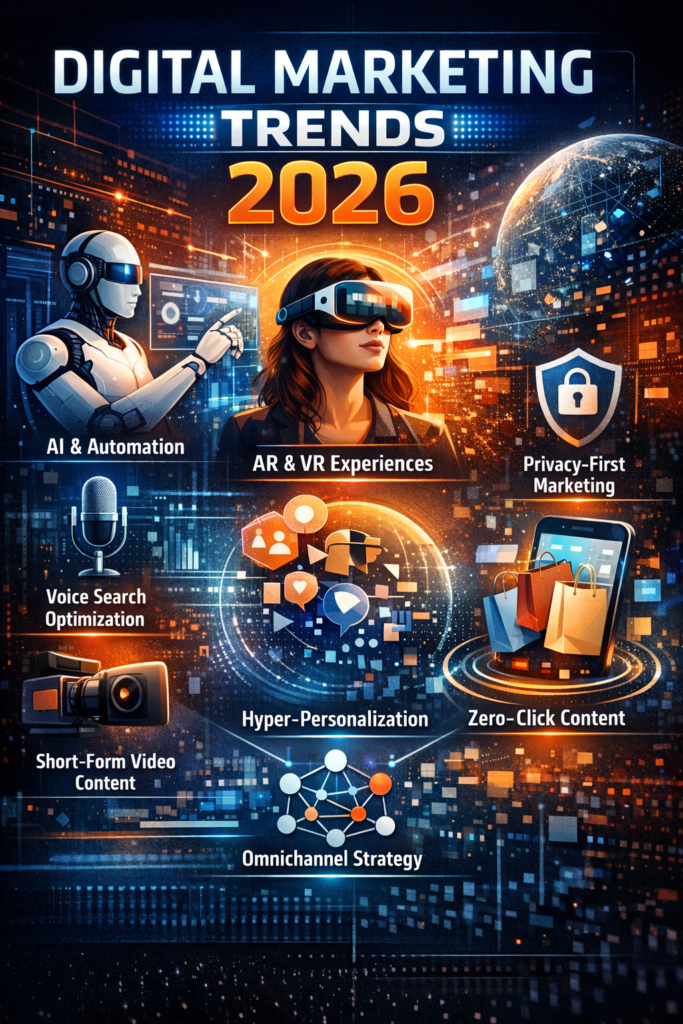
Digital Marketing Trends in 2026: The Ultimate Guide for Businesses and Marketers
Introduction: Why 2026 Is a Defining Year for Digital Marketing
Digital marketing has never stood still—but 2026 marks a defining evolution rather than a simple change. The industry is shifting from volume-driven tactics to precision, personalization, privacy, and performance. Brands that once competed on ad spend are now competing on experience, intelligence, and trust.
Advancements in artificial intelligence, automation, data ethics, immersive technologies, and consumer behavior are reshaping how businesses connect with audiences. Traditional funnels are fading, third-party cookies are disappearing, and attention spans are shorter than ever.
In this in-depth guide, we’ll explore the most impactful digital marketing trends of 2026, how they’re reshaping the industry, and what businesses must do to stay competitive in a rapidly evolving digital landscape.
1. AI-Driven Marketing Becomes the Industry Standard
Artificial Intelligence is no longer a “trend”—it’s the core engine behind digital marketing strategies in 2026.
Key Developments:
AI-generated content with human-like tone and context
Predictive analytics for customer behavior
Automated media buying and ad optimization
AI-powered SEO and keyword intent mapping
Marketers are now using AI not just to create content, but to decide what content to create, when to publish it, and which audience segment will convert best.
Impact on Businesses:
Faster campaign execution
Reduced operational costs
Hyper-personalized customer journeys
Data-driven decision making at scale
SEO Tip:
Use AI as an assistant, not a replacement. Human creativity and strategic thinking remain critical for brand differentiation.
2. Search Engines Are Shifting from Keywords to Intent
In 2026, search engines prioritize search intent over exact-match keywords. Google and other platforms now understand why a user is searching, not just what they’re typing.
What This Means for SEO:
Long-form, authoritative content ranks better
Semantic search is dominant
Topic clusters outperform isolated blog posts
User experience metrics matter more than ever
Instead of optimizing for one keyword, brands must now optimize for entire search journeys.
Winning SEO Strategies in 2026:
Build content hubs around core topics
Answer real user questions clearly
Optimize for featured snippets and zero-click searches
Improve page speed, UX, and accessibility
3. Voice Search and Conversational Marketing Dominate
With smart assistants, wearable devices, and voice-enabled cars becoming mainstream, voice search usage has exploded in 2026.
How Voice Search Changes Marketing:
Queries are longer and more conversational
Local searches dominate voice queries
Question-based content performs better
Natural language SEO is essential
Actionable Tips:
Optimize for “who, what, when, where, why” queries
Use conversational headings and FAQs
Focus on local SEO and Google Business profiles
Voice is no longer optional—it’s a critical channel for discovery and engagement.
4. The Rise of Zero-Click Content and On-Platform Experiences
In 2026, users consume content without leaving platforms. Social media, search engines, and marketplaces aim to keep users inside their ecosystems.
Examples:
Google featured snippets
Instagram and LinkedIn long-form posts
In-app shopping experiences
Native lead generation forms
Marketing Shift:
Brands must design content that delivers value instantly, even if users never visit the website.
Smart Approach:
Create snackable, high-impact content
Optimize for platform-native formats
Focus on brand recall and trust, not just clicks
5. First-Party Data and Privacy-First Marketing
With stricter data regulations and the complete phase-out of third-party cookies, privacy-first marketing is non-negotiable in 2026.
What’s Changing:
Consent-based data collection
Greater transparency in tracking
Stronger emphasis on owned data
Winning Strategies:
Build email and SMS subscriber lists
Use CRM and CDP platforms
Offer value in exchange for data (guides, tools, memberships)
Brands that respect user privacy build stronger trust and loyalty, which directly impacts long-term growth.
6. Hyper-Personalization at Scale
Personalization in 2026 goes far beyond adding a first name to an email. It’s now behavior-driven, real-time, and predictive.
Examples of Hyper-Personalization:
Dynamic website content based on user behavior
Personalized pricing and offers
AI-driven email journeys
Product recommendations powered by intent data
Why It Matters:
Consumers expect brands to understand their needs instantly. Generic marketing messages are ignored.
Result:
Higher engagement, better conversions, and increased customer lifetime value.
7. Short-Form Video Continues to Rule Attention
Short-form video remains the most powerful content format in 2026 across platforms like Instagram Reels, YouTube Shorts, LinkedIn Video, and emerging social networks.
What’s Different in 2026:
More educational content, not just entertainment
Storytelling within 30–60 seconds
Vertical video optimized for mobile-first audiences
Best Practices:
Focus on value within the first 3 seconds
Add captions for silent viewers
Repurpose videos across platforms
Maintain brand consistency
Video is no longer optional—it’s essential for visibility and engagement.
8. Influencer Marketing Shifts to Micro and Nano Creators
Celebrity influencers are losing effectiveness. In 2026, micro and nano influencers deliver better ROI due to higher trust and engagement.
Why Smaller Influencers Win:
Authentic audience relationships
Niche-specific expertise
Lower costs with better conversion rates
Smart Influencer Strategy:
Focus on relevance, not follower count
Build long-term creator partnerships
Measure performance beyond likes and views
Authenticity is the new currency of influence.
9. Immersive Experiences with AR and VR
Augmented Reality (AR) and Virtual Reality (VR) are transforming how customers experience brands online.
Use Cases in 2026:
Virtual product try-ons
3D product demos
Virtual showrooms and events
Interactive brand storytelling
These technologies reduce purchase hesitation and improve customer confidence—especially in eCommerce and real estate.
10. Performance Marketing Meets Brand Marketing
The old debate between performance vs branding ends in 2026. The most successful campaigns combine both.
New Marketing Philosophy:
Data-driven creativity
Emotional storytelling backed by analytics
Brand trust as a conversion driver
Marketers now measure:
Attention quality
Brand sentiment
Long-term customer value
Strong brands convert better, faster, and cheaper.
11. Omnichannel Marketing Is No Longer Optional
Customers interact with brands across multiple touchpoints—social, email, search, apps, and offline.
In 2026, Omnichannel Means:
Unified customer data
Consistent messaging
Seamless transitions between platforms
Brands that fail to integrate channels risk fragmented experiences and lost revenue.
12. Content Quality Beats Content Quantity
In the past, publishing frequently mattered. In 2026, publishing thoughtfully matters more.
What High-Quality Content Looks Like:
Deep insights
Actionable advice
Expert-level authority
Clear structure and readability
Search engines reward content that genuinely helps users—thin content disappears.
Final Thoughts: Preparing for the Future of Digital Marketing
Digital marketing in 2026 is smarter, more ethical, more personalized, and more human—despite the rise of automation and AI.
Key Takeaways:
Embrace AI, but lead with strategy
Prioritize user experience and trust
Invest in content authority and authenticity
Adapt to privacy-first ecosystems
Focus on long-term brand value, not short-term hacks
The future belongs to marketers who adapt early, think deeply, and execute intelligently.